PAC Forked to Asbru

Refer: https://www.asbru-cm.net/

Ubuntu 20.04

Refer: https://docs.asbru-cm.net/General/Installation/#ubuntu

sudo apt-add-repository multiverse
sudo apt install curl
curl -s https://packagecloud.io/install/repositories/asbru-cm/asbru-cm/script.deb.sh | sudo bash
sudo apt install asbru-cm

Debian

curl -s https://packagecloud.io/install/repositories/asbru-cm/asbru-cm/script.deb.sh | sudo bash
sudo apt install asbru-cm

Fedora

curl -s https://packagecloud.io/install/repositories/asbru-cm/asbru-cm/script.rpm.sh | sudo bash
sudo dnf install asbru-cm 

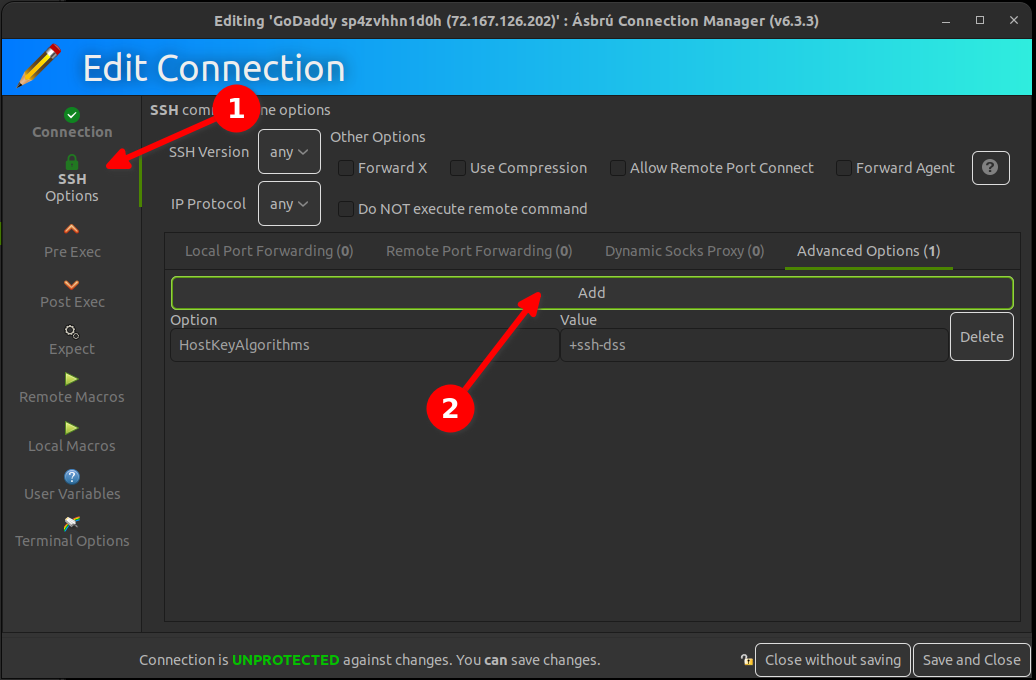
Getting GoDaddy to Work

Visual Studio Code Missing Underline Character

Easier solution is to just set the terminal font to monospace
Refer: https://github.com/microsoft/vscode/issues/35901

Refer: https://github.com/microsoft/vscode/issues/35901

The underscore or underline character is missing in Visual Studio Code terminal.  I changed the fonts to match Sublime and the font was too small.

{
    "terminal.integrated.fontFamily": "Monospace",
    "terminal.integrated.fontSize": 15,
    "python.pythonPath": "/usr/bin/python",
    "python.linting.pylintEnabled": true,
    "python.linting.enabled": true
}

Allow more than one version of Portable Firefox to run

Refer: https://portableapps.com/node/23783

WORKS!
This solution was given by other authors as well - but i want to repeat and emphasis that it REALLY WORKS - and its simple as 1-2-3:

  • From the directory where your "FirefoxPortable.exe" is (let's call it appRootDir) you go to directory "Other\Source\"
  • copy the file "FirefoxPortable.ini" to the appRootDir
  • change line "AllowMultipleInstances=false" to "AllowMultipleInstances=true" in the copied "FirefoxPortable.ini" in appRootDir

Sample Location:

C:\Users\mruckman\Documents\PortableApps\PortableApps\FirefoxPortable\FirefoxPortable.ini

FirefoxPortable-ini.txt

Using keyboard with Ubuntu Terminal

Refer: https://askubuntu.com/questions/822262/how-do-i-get-menu-accelerator-keyboard-shortcuts-to-work-in-terminal

Apparently Gnome Terminal is different from "normal" apps and has accelerators turned off by default? (Why is this?)

Anyway, the solution was to go to Edit menu -> Preferences -> General and enable the "Enable mnemonics" checkbox.

How to delete the Windows.old folder from Windows 10

If you upgraded your PC from a previous version of Windows, consider getting rid of this space-hogging folder.

Did you upgrade your PC to Windows 10? If so, ever wonder what happened to the previous version of the OS? It probably disappeared into the mists of Windows past, right?

Wrong. Your old OS didn't get erased; rather, it's lingering in a system folder called, aptly enough, Windows.old. And depending on the size of that version, it could be hogging a lot of precious space.

First things first: If you think you might want to downgrade from Windows 10 back to the previous version, don't delete that folder.

Second, unless you're seriously strapped for space on your hard drive, you don't have to do anything: Windows 10 will automatically delete the Windows.old folder one month after you performed your upgrade.

If you'd rather not wait -- if you want to reclaim that storage now -- you can delete the folder immediately, though not in the way you might expect. Indeed, if you simply click the folder and then press the Delete key, Windows will tell you you need permission, yada-yada, etc.

Here's the proper way to delete the Windows.old folder:

Step 1: Click in Windows search field, type Cleanup, then click Disk Cleanup.

Step 2: Click the "Clean up system files" button.

Step 3: Wait a bit while Windows scans for files, then scroll down the list until you see "Previous Windows installation(s)."

Step 4: Check the box next to the entry, then make sure there are no other boxes checked (unless you do indeed want to delete those items). Click OK to start the cleanup.

Install SQL Developer on Ubuntu 18.04 with OpenJDK 8

## Install Java 8 SDK

```Bash
sudo add-apt-repository ppa:openjdk-r/ppa
sudo apt-get -y update
sudo apt-get -y install openjdk-8-jdk
```

## Install Oracle SQL Developer

Before you can use SQL Developer with OpenJDK 8, you need to install JFX. Please note, that Oracle does not officially support OpenJDK, but it does work; however, you need to use JFX version 8. You will have to download the "Other Platform" where the JRE is NOT included with the installation.

Refer: <https://www.oracle.com/technetwork/developer-tools/sql-developer/downloads/index.html>

## Install JFX

Refer: <https://stackoverflow.com/questions/52484814/oracle-sql-developer-problem-initializing-welcome-page>

```Bash
sudo apt install -y libopenjfx-java=8u161-b12-1ubuntu2 --allow-downgrades
sudo apt install -y libopenjfx-jni=8u161-b12-1ubuntu2 --allow-downgrades
sudo apt install -y openjfx=8u161-b12-1ubuntu2 --allow-downgrades
```

Verify you have OpenJFX 8 installed:

```Bash
dpkg -l | grep openjfx
```

Location of Java, required for Oracle SQL Developer:

```Text
/usr/lib/jvm/java-8-openjdk-amd64
```

Brasero ISO Images

Refer: http://manpages.ubuntu.com/manpages/bionic/man1/bchunk.1.html
Refer: https://unix.stackexchange.com/questions/29671/how-can-i-convert-a-cue-bin-with-cdr-tracks-image-into-a-single-iso-file/29675

Save file as CUE file, and after the *.bin and *.cue files are created

bchunk [-v] [-p] [-r] [-w] [-s] <image.bin> <image.cue> <basename>

$ bchunk QUEEN.bin QUEEN.cue QUEEN.iso

If the BIN file contains CD-Audio tracks you cannot convert it to an ISO image! The reason for this is that, unlike e.g. a CD-ROM, the data structure of an audio CD is fundamentally incompatible with an ISO 9660 file system. See the link below for a paper that gives a good explanation of this:

http://journal.code4lib.org/articles/9581

However, you could use bchunk (as suggested above) with the -w option, which generates output in WAV format. Command line would be something like this:

bchunk -s -w IMAGE.bin IMAGE.cue IMAGE

This will create WAV files for each audio track, e.g.:

IMAGE001.wav
IMAGE002.wav

$ bchunk -s -w QUEEN.bin QUEEN.cue QUEEN