Different databases have different ways of concatenating strings. In Oracle or Postgres, try this:
SELECT SUM(K.Score)
FROM Wreck_it_Ralph WIR, Keyword k
WHERE t_text LIKE '%' || k.word || '%'

Technical notes, and other ideas.
Different databases have different ways of concatenating strings. In Oracle or Postgres, try this:
SELECT SUM(K.Score)
FROM Wreck_it_Ralph WIR, Keyword k
WHERE t_text LIKE '%' || k.word || '%'
There is a program available on Ubuntu youtube-dl, that can download videos from youtube.com or other video platforms. But it stores the file in mp4, since it contains video. But sometimes you do not want the video and only the audio. To extract only the audio part, you can use the pacpl comamnd line tool.
Use "Sound Converter" Application for simple conversion
Usage:
$ youtube-dl -f mp4 --output "yourfilename.%(ext)s" https://youtu.be/your-link-here
$ youtube-dl --extract-audio --audio-format mp3 --audio-quality 256 --output "yourfilename.%(ext)s" https://youtu.be/your-link-here
Older Method:
pacpl --to mp3 -v -r -bitrate 256 targetfile.mp4
Ubuntu Software: EasyTAG to modify MP3 MetaData
Update MP3 tags with the command line:
$ sudo apt-get install id3v2
Some useful commands
List all of the tags or specific for a particular file without wild card
$ id3v2 -l *.mp3
Example of how to update title, album, year
$ id3v2 -t "My Title" file-to-update.mp3
$ id3v2 -a "My Album"
$ id3v2 -y 2016
Looking for bash script includes which use a period but NOT a preceding slash. Slick little regex example:
$ grep "^\. [^/]*sh" *
The issue with recoding Snagit sessions, is it puts the audio on two tracks and when uploading it to YouTube, the audio disappears. Use VLC to see how the audio would play. Using QuickTime to convert the video. iMove does the same thing too, but it takes lots of resources as it imports media into it's library.
Steps to Process with QuickTime 7


Steps to Process with iMovie
Please see attached sample Perl Script.
# Take a current snapshot
# Start appliance and open a terminal
$ sudo apt-get update
$ sudo apt-get install build-essential
# Reinstall the Guest Editions
Devices, "Insert Guest Editions CD Image..."
Run, Enter your credentials, and let it install
Reboot your Appliance
# See if it works, and if it does
Shutdown, delete snapshot and take new snapshot
Refer: http://ubuntuforums.org/showthread.php?t=1632528
Run the three commands:
$ sudo apt-get install -f
$ sudo dpkg --configure -a
$ sudo apt-get update && sudo apt-get upgrade
When launching the SQL Developer bash script it asked for the Java location, could not find it.
If you’ve installed Java 7, and you launch SQL Developer, use this as the path, or the equivalent:
/usr/lib/jvm/java-7-oracle
You can set your java_home but this does not help the above:
sudo nano /etc/environment
JAVA_HOME=/usr/lib/jvm/java-7-oracle
SQL Developer that works with Java 7:
http://www.oracle.com/technetwork/developer-tools/sql-developer/downloads/sqldev-downloads-403-2529784.html
sqldeveloper-4.0.3.16.84-no-jre.zip
Bonus:
Use Filter: WEB% for HAL
# Example to quickly look for a deleted file
$ git log --diff-filter=D --summary | grep -i delete | grep -i barclay
Use this to find actual commit for file and you can search it like a less command
$ git log --diff-filter=D --summary
Refer: http://stackoverflow.com/questions/7203515/how-to-locate-a-deleted-file-in-the-commit-history
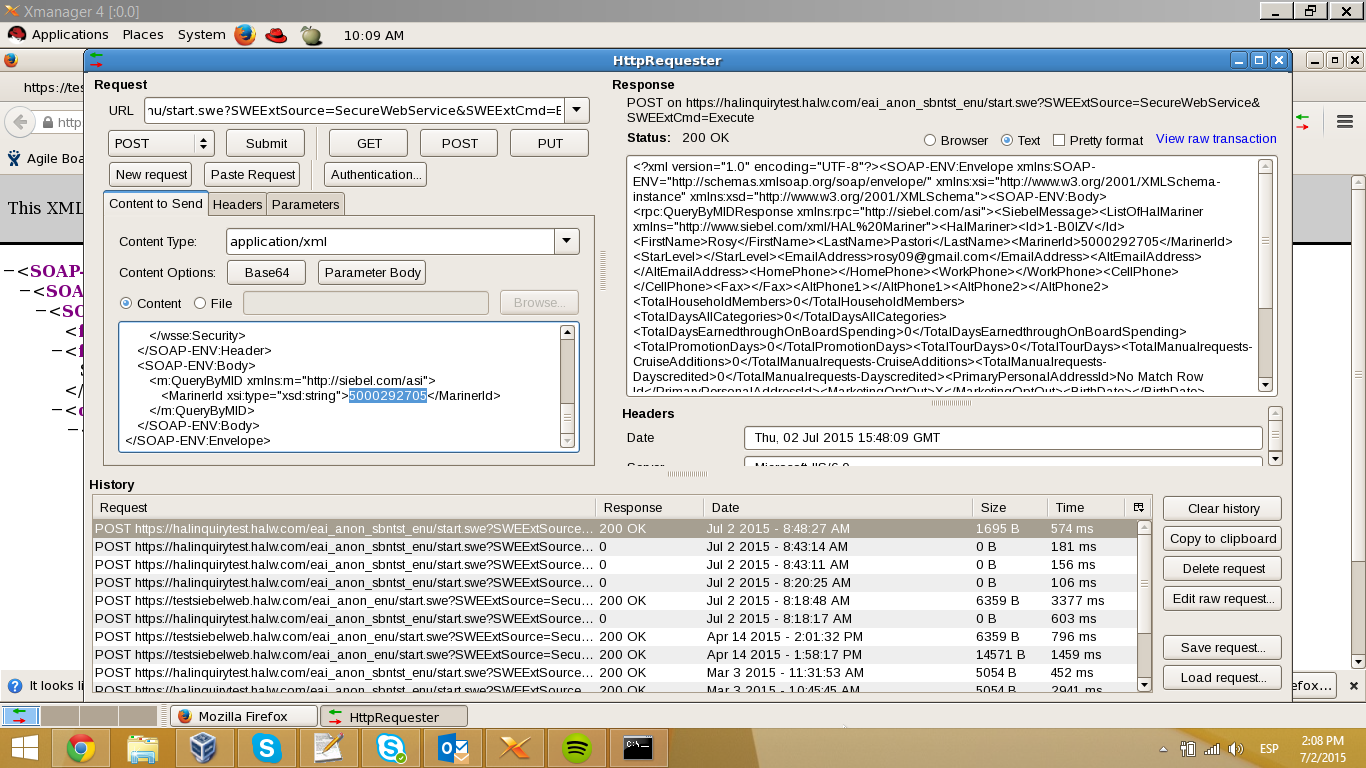
CJ, just check Siebel for SBN and is not returning the middle name…. if the middle was null it should return the tags empty, but in this case that tag is not commig. <CellPhone />
Here is a print screen from my VM that is inside HAL’s network. Haldevjbs22.