
Installing MongoDB Ubuntu14.04 and Specific Version of MongoDB

Installing MongoDB in Ubuntu
Refer: http://docs.mongodb.org/manual/tutorial/install-mongodb-on-ubuntu/

Import Public Key
$ sudo apt-key adv --keyserver hkp://keyserver.ubuntu.com:80 --recv 7F0CEB10

Create a list file for MongoDB
$ echo "deb http://repo.mongodb.org/apt/ubuntu "$(lsb_release -sc)"/mongodb-org/3.0 multiverse" | sudo tee /etc/apt/sources.list.d/mongodb-org-3.0.list

### NOTE !!! We need this repository for 2.6.3 installation ###

$ echo 'deb http://downloads-distro.mongodb.org/repo/ubuntu-upstart dist 10gen' | sudo tee /etc/apt/sources.list.d/10gen.list

Reload local package database
$ sudo apt-get update

Install MongoDB packages

Either latest - STOP - Do you want latest?
$ sudo apt-get install -y mongodb-org

or Specific version
$ sudo apt-get install -y mongodb-org=2.6.3 mongodb-org-server=2.6.3 mongodb-org-shell=2.6.3 mongodb-org-mongos=2.6.3 mongodb-org-tools=2.6.3

Pin a specific version of MongoDB.

Although you can specify any available version of MongoDB, apt-get will upgrade the packages when a newer version becomes available. To prevent unintended upgrades, pin the package. To pin the version of MongoDB at the currently installed version, issue the following command sequence:

$ echo "mongodb-org hold" | sudo dpkg --set-selections
$ echo "mongodb-org-server hold" | sudo dpkg --set-selections
$ echo "mongodb-org-shell hold" | sudo dpkg --set-selections
$ echo "mongodb-org-mongos hold" | sudo dpkg --set-selections
$ echo "mongodb-org-tools hold" | sudo dpkg --set-selections

Versions of the MongoDB packages before 2.6 use a different repo location. Refer to the version of the documentation appropriate for your MongoDB version.

Run MongoDB

The MongoDB instance stores its data files in /var/lib/mongodb and its log files in /var/log/mongodb by default, and runs using the mongodb user account. You can specify alternate log and data file directories in /etc/mongod.conf. See systemLog.path and storage.dbPath for additional information.

If you change the user that runs the MongoDB process, you must modify the access control rights to the /var/lib/mongodb and /var/log/mongodb directories to give this user access to these directories

Start MongoDB.

Issue the following command to start mongod:
$ sudo service mongod start

Verify that the mongod process has started successfully by checking the contents of the log file at /var/log/mongodb/mongod.log for a line reading
[initandlisten] waiting for connections on port <port>
where <port> is the port configured in /etc/mongod.conf, 27017 by default.

$ sudo service mongod status

Stop MongoDB.
As needed, you can stop the mongod process by issuing the following command:
sudo service mongod stop

Restart MongoDB.

Issue the following command to restart mongod:
$ sudo service mongod restart

Keeping it from auto-starting:
Refer: http://edgar.tumblr.com/post/3242138398/disable-start-of-a-service-on-boot-in-ubuntu
/etc/init/mongod.conf
ENABLE_MONGOD="yes" -> "no"

Using RoboMongo

Name: localhost
Address: localhost:27017

Removing MongoDB

Refer: http://askubuntu.com/questions/497139/how-to-completely-uninstall-mongodb-2-6-3-from-ubuntu-13-04

$ sudo dpkg -l | grep mongo

That should output a list of packages with mongo in the name.

If there are still files left on the system following an apt-get remove mongo, try and run the command again with the --purge switch, using a wildcard search for the name:

Such as, but review the above command, you will probably need to customize this:
$ sudo apt-get remove mongodb* --purge

Real Example on Ubuntu 14.04
$ sudo apt-get remove mongodb-org mongodb-org-mongos mongodb-org-server mongodb-org-shell mongodb-org-tools --purge
 

Install PAC SSH Manager in Ubuntu

Official Download: http://sourceforge.net/projects/pacmanager/ Refer: http://linuxg.net/how-to-install-pac-manager-4-5-2-on-ubuntu-linux-mint-and-debian/ PAC Manager is a GUI for SSH and telnet, similar to Putty.

Issues after upgrade from Ubuntu 14.04 to Ubuntu 16.04.  Needed to run the following commands, you need to remove and re-install PAC.

$ sudo apt-get remove pac
$ sudo rm -rf /opt/pac
$ sudo dpkg -i pac-4.5.5.7-all.deb

This did NOT work:

$ find /opt/pac/ -name "Vte.so*" -exec rm {} +
Refer:  https://sourceforge.net/p/pacmanager/bugs/177/


How install Minecraft on Ubuntu 14.04

Refer: http://www.howtogeek.com/198476/how-to-install-minecraft-on-ubuntu-or-any-other-linux-distribution/

The most important part was installing the Nvidia drivers, and then Oracle Java 7+.  Download the Jar file, make it executable through file menu, and just double clicking the icon.  Also, reduced the frame rate, etc. for other items to make it a bit more performant.

Remove nvidia splash screen

After installing the the nvidia graphic drivers for Ubuntu 14.04, an Nvidia splash would keep appearing during logon.

One command to disable Nvidia logo
Refer: http://ubuntuhandbook.org/index.php/2013/08/remove-nvidia-logo-from-ubuntu-startup-screen/

The easiest way to do this is running below command in terminal (press Ctrl+Alt+T):
$ sudo nvidia-xconfig --no-logo

Lexmark Prevail Pro 705 Install with Ubuntu

This driver works with Ubuntu 14.04 64-bit
Works-Ubuntu-14-lexmark-inkjet-legacy-wJRE-1.0-1.amd64.deb.sh_Pro900.tar.gz

Extract it in your downloads folder, and it's a single *.sh
$ sudo su -

And execute the script and follow the prompts.
Refer: http://support.lexmark.com/index?docLocale=en_US&page=content&id=DR20854&locale=EN&userlocale=EN

Actual filename: lexmark-inkjet-legacy-wJRE-1.0-1.amd64.deb.sh_Pro900.tar.gz

If you get this error you will need to uninstall a previous version of the Lexmark drives

The installer has detected previously installed component. -- lexmark-inkjet-legacy Please remove the installed component and run the installer again.

sudo apt-get --purge remove lexmark-inkjet-legacy
sudo apt-get --purge remove lexmark-wsu-legacy

Older Notes or 32-bit version of Ubuntu - Kept for reference

Refer: lexmark.com

Printer driver (with JRE) for 32-bit Linux distributions with Debian-based packaging
File Name: lexmark-inkjet-legacy-wJRE-1.0-1.i386.deb.sh.tar.gz
Released 10/25/2011
Version: 1.0.1
File Size 4.9859946E7
Release Notes

This package installs a printer driver for 32-bit Linux distributions with Debian-based packaging. The following components will be installed on your system along with the printer driver:

Lexmark Printer Toolbox - allows users to perform maintenance operations on the device and check ink levels of the cartridges

Wireless Setup Utility - allows users to configure the wireless settings for wireless capable printers

This package is installed with Java Runtime Environment (JRE), used for running Java applications.

INSTALLATION INSTRUCTIONS

IMPORTANT: Follow these steps only if your printer is listed in the Linux Home Office and SMB Products compatibility page.

A. RUNNING THE GUI INSTALLER SCRIPT FROM THE TERMINAL

Open up your favorite terminal (xterm, konsole, gnome-terminal, etc)

Extract the zip file
Use the following command to install the driver
DEB-based distros:

# ./lexmark-inkjet-[xx]-driver-[x.x.x]..i386.deb.sh
Follow the instruction in the installation screen.

B. RUNNING THE GUI INSTALLER SCRIPT
Do not attach the printer via USB to the Linux machine.
Extract the zip file.
For DEB-based systems: lexmark-inkjet-[xx]-driver-[x.x.x].i386.deb.sh

Run the installer script file by double-clicking on the file icon and then click the ""Run in Terminal"" button or run the script file via command-line.

Follow the instructions in the installer screen.

Remove guest account from Ubuntu

Just press Ctrl+Alt+T on your keyboard to open Terminal. When it opens, run the command(s) below:

sudo nano /usr/share/lightdm/lightdm.conf.d/50-ubuntu.conf

Add the following line, save and close.

allow-guest=false

Reboot, and you're set.

Using nginx as a reverse proxy, installing in Ubuntu 14.04

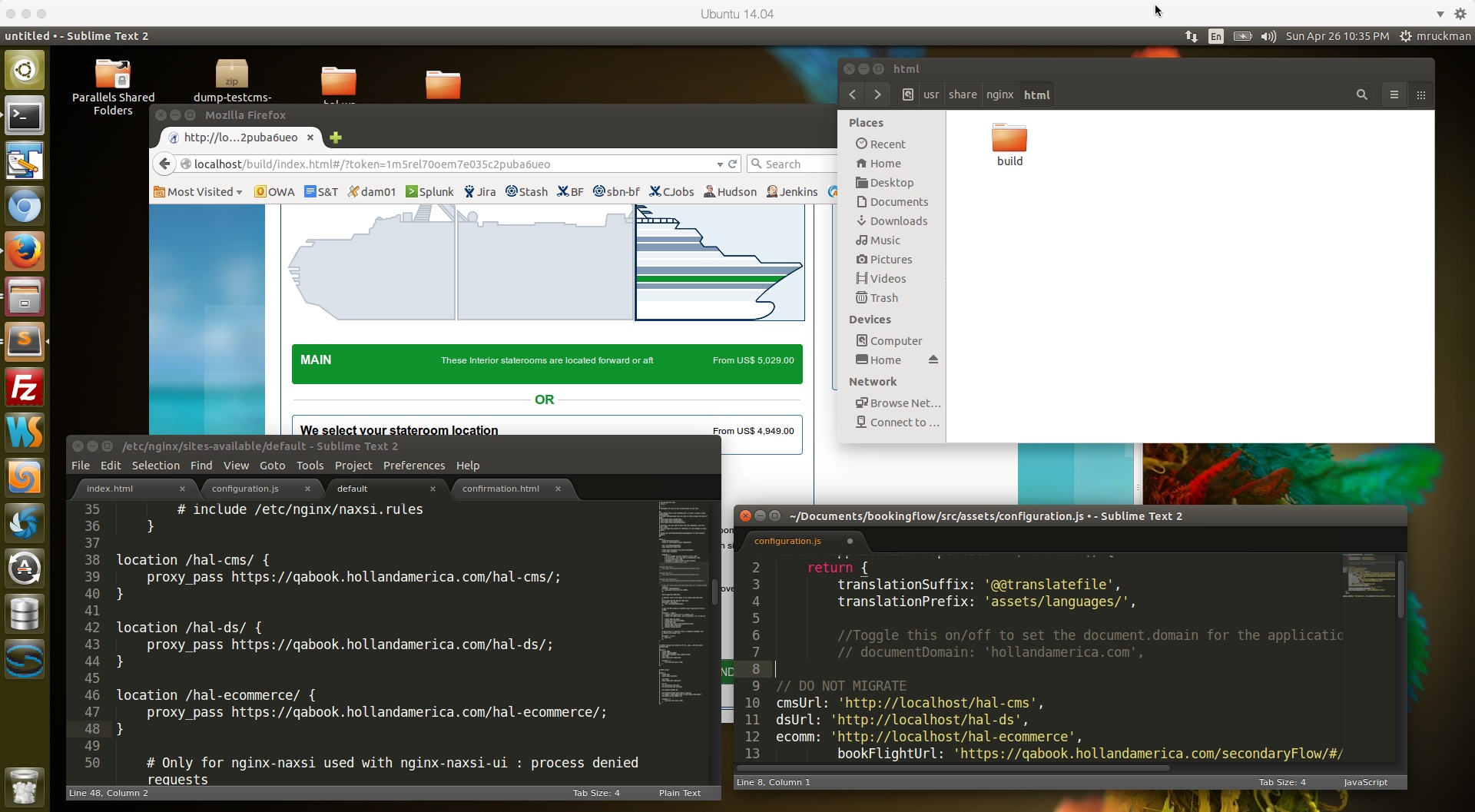
Sample nginx configuration changes:
nginx.conf
default

nginx-example-2015-04-26_22-35-21

Install nginx in Ubuntu 14.04
Refer: https://www.digitalocean.com/community/tutorials/how-to-install-nginx-on-ubuntu-14-04-lts

$ sudo apt-get update
$ sudo apt-get install nginx

It runs under localhost by default.

Manage the Nginx Process

$ sudo service nginx stop
$ sudo service nginx start
$ sudo service nginx restart

Location of default HTML files for nginx:
/usr/share/nginx/html

Change permissions to allow easy access to files:
$ sudo chown -R $USERID:$USERID /usr/share/nginx/html
$ sudo chmod -R 755 /usr/share/nginx/html

You can copy the "build" folder there now for testing, make sure to restart nginx
http://localhost/build/index.html#/?token=1m5rel70oem7e035c2puba6ueo

Additional Setup for Reverse Proxy

Refer: https://www.digitalocean.com/community/tutorials/how-to-set-up-nginx-server-blocks-virtual-hosts-on-ubuntu-14-04-lts

Uncomment One Line
$ sudo gedit /etc/nginx/nginx.conf

### BEGIN SNIPPET 1 OF 2 ###
server_names_hash_bucket_size 64;
### END SNIPPET 1 OF 2 ###

You can edit the default nginx property file here, with 3 reverse proxy examples, and ucomment one line, and restart:
$ sudo gedit /etc/nginx/sites-available/default

### BEGIN SNIPPET 2 of 2 ###
location /hal-cms/ {
proxy_pass https://qabook.hollandamerica.com/hal-cms/;
}

location /hal-ds/ {
proxy_pass https://qabook.hollandamerica.com/hal-ds/;
}

location /hal-dsbooking-server/ {
proxy_pass https://qabook.hollandamerica.com/hal-dsbooking-server/;
}

location /hal-ecommerce/ {
proxy_pass https://qabook.hollandamerica.com/hal-ecommerce/;
}

# Only for nginx-naxsi used with nginx-naxsi-ui : process denied requests
#location /RequestDenied {
# proxy_pass http://127.0.0.1:8080;
#}
### END SNIPPET 2 0f 2 ###

Verify your nginx configuration
$ sudo nginx -c /etc/nginx/nginx.conf -t

UI Code Monkey Patch Example:

// DO NOT MIGRATE
cmsUrl: 'http://localhost/hal-cms',
dsUrl: 'http://localhost/hal-ds',
ecomm: 'http://localhost/hal-ecommerce',

NOTE: Make sure to restart Nginx after all of your configuration changes

$ sudo service nginx restart